

About CameronLife

The CameronLife Photo Library was originally conceived by our father, Charles Everest, early in his career with the purpose of holding and curating his freelance photographic, film and media works. The resulting archive covers a period from the early 1950’s into the 2000’s and beyond, with Charles actively taking pictures well into his 80’s.
Sadly, Dad passed away in 2015.
The copyright ownership and the day-to-day operation of the CameronLife Photo Library now rests in the hands of his children and their families. They have been actively involved with the archive for the best part of twenty years.
Our primary objectives remain the conservation and promotion of his film and photographic works that contain historically and socially important material covering a vast array of subject matter.
We showcase and promote the Library content through many mediums including exhibitions, social media, talks, the sale of printed images, through licencing to publishers of books and magazines, for tv and film productions, and to the music industry for album covers etc.
The revenue helps to fund the expensive and time consuming processes of conservation and restoration to ensure that Charles’ documentary and artistic works can be preserved for the enjoyment of present and future generations.
True to Charles’ wishes, we will be adding contemporary material to the library produced in-house, by the CameronLife team.
We are also looking to develop opportunities for selected photographers and film makers in the near future.
About Charles Everest
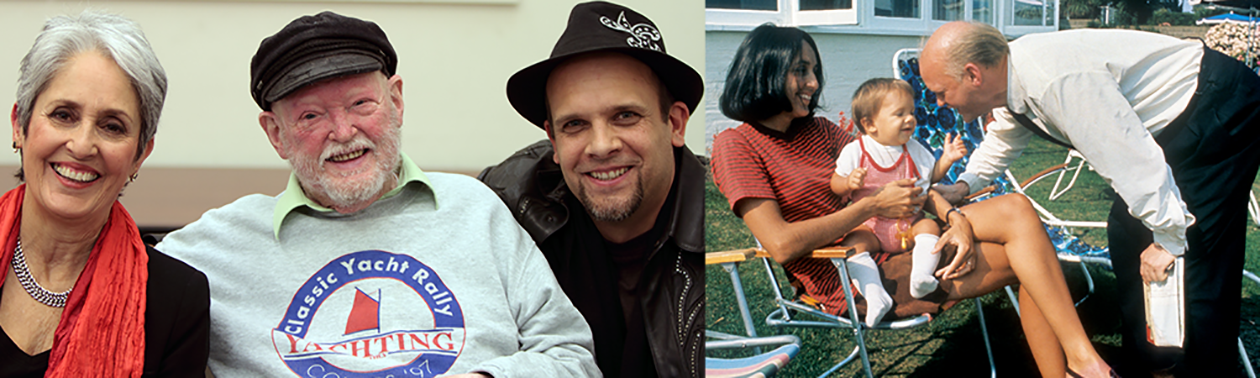
Charles re-united with Joan Baez & Gabe Harris in Sheffield 2012 after they last met back in1970 at the hotel prior to her IOW Festival performance.
John Charles Everest (1929-2015)
John Charles Everest was born on the 12th February 1929, with a hereditary illness (decades later diagnosed as Hyperhidrotic Ectodermal Dysplasia, or HED). He was fortunate to live beyond childhood and showed amazing will power and single mindedness to live a "normal" existence and hold down a challenging career.
Born into a family with a tradition in service to sovereigns and aristocrats, Charles had an interesting and privileged childhood. The freedom to mix with a cross-section of estate workers gave this young boy a lifetime interest in people and the everyday lives they lead. A growing passion for photography, combined with mentoring by the renowned photographer and Royal Warrant holder James Sheridan (father of actress Dinah Sheridan), led to successful submissions to local newspapers, trade, and county magazines and from there he achieved National media exposure.
National Service gave John an introduction to personnel records, camera work and to cataloguing and servicing military training films. After which, freelance work took him to Edinburgh and to the features company of 'The Scotsman' newspaper. Charles (as he became known in his film and photography work) so impressed Roy Thomson (Canadian millionaire radio and newspaper owner, who was about to establish commercial television in Scotland), that he was given the opportunity of a career in filming for him. However, an offer from a BBC News contractor was too good to miss and resulted in Charles covering the Northern territories reaching to the Arctic Circle and the many Islands of and beyond Scotland.
Tenacity, focus and attention to detail helped him carve out a successful career as an award-winning National and International newsreel cameraman, documentary and children’s TV film cameraman, director and stills photographer.
Charles’ real love was covering “hard news” events, including his 1951 award winning, world exclusive of the Lynmouth flood disaster. He was accredited to cover Royal visits, State visits, and official visits of foreign Heads of State and Prime Ministers from Churchill to Callaghan. Other areas he regularly covered are listed below: -
- Coverage of major national and international sports including Powerboat, Yacht, Motor and Aircraft racing.
- Recording Industrial research, development and applications including prototype testing of aircraft, lifeboats, hovercraft, nuclear submarines, liners, and warships.
- Military and Naval exercises and ceremonials, fleet reviews and Royal processions including Garter, Bath, and Thistle Knights ceremonies.
- Focusing on Emergency Services operations, air, sea, underground pit, fire, and flood disasters.
This list describes a fraction of the subjects covered, during a career of almost sixty-years in photojournalism.
So where does his coverage of a Music Festival fit in?
Festival Biography Charles Everest
By 1970, already established with a strong reputation through work with the BBC and ITN, and living on the Isle of Wight, Charles Everest found himself unexpectedly drawn into one of the most iconic music events of the era: the Isle of Wight Festival. The organisers, aware of his standing, approached him to assist in the lead-up to the event. Initially hesitant due to existing commitments, he ultimately agreed, recognising the unique opportunity it presented.
His first role was as a Press Liaison Officer, responsible for vetting the flood of applications from television, radio, and media organisations arriving from across the globe. This administrative role continued into the festival itself, as he managed late arrivals and ensured media access was properly controlled.
In exchange for his time, he negotiated a position that would prove pivotal to his legacy: permission to photograph the performances from the side of the stage rather than from the designated press area. This vantage point allowed him an intimacy and immediacy rarely afforded to photographers. Working with multiple cameras—primarily 35mm, alongside a Hasselblad—he shot predominantly in colour, with occasional black-and-white images. Each camera was prepared for different conditions, enabling him to react quickly in a fast-moving environment.
Throughout the festival, he operated as a freelance photographer, distinct from the event’s official photographer. Positioned among speakers and stage equipment, he carefully navigated a challenging physical space to capture unique perspectives. His privileged access was not always welcomed by those confined to the press enclosure, but it enabled him to produce a body of work that stood apart.
His commitment to documenting the event was relentless. Present on-site for the entire duration, he slept little—often no more than an hour a night—grabbing rest wherever he could. His aim was simple: to capture as much of the festival’s atmosphere and activity as possible, both on and off stage.
Beyond the performances, he also documented the wider phenomenon surrounding the festival. He witnessed the growth of the crowds on Afton Down—dubbed “Desolation Hill”—where thousands gathered for a free vantage point overlooking the stage. The scale of the event was immense, though at the time he was too focused on his work to fully appreciate its historical significance.
Among the many artists he photographed was Jimi Hendrix, with whom he had several conversations both backstage and during the performance. Their exchanges revealed a more introspective side of the musician. One particularly notable image, often referred to as the “Jimi Pensive” photograph, emerged from a quiet moment when he encouraged Hendrix to reflect on what mattered most in life beyond performance. The resulting image captured a rare and contemplative expression.
Despite taking over a hundred photographs of Hendrix alone, he recalls a lingering sense of missed opportunities—moments and angles that slipped away even under ideal access. This sense of pursuit, of always seeking the next perfect shot, remained central to his approach.
After the festival concluded, his work did not immediately end. He stayed on for several days, documenting the aftermath and the clearing of the site. Exhausted from days of near-constant activity, he left with a remarkable photographic record of an event that would later be recognised as one of the defining cultural moments of its time.
In retrospect, while he did not fully grasp the festival’s iconic status as it unfolded, his photographs have become an enduring testament to its scale, atmosphere, and humanity—captured through the lens of someone wholly immersed in the moment.
Charles had moved to the Isle of Wight with his family as a freelance in 1960 to cover BBC local news filming for the South Coast and Isle of Wight. In 1970 he was in the right place at the right time! He described his Photographing of the festival as “The most tiring assignment I ever undertook”, as he stayed awake for almost every hour of the five days!
Please take a good look at his festival photographs. We are sure you, like us, will think his efforts were worthwhile.
Charles sadly passed away aged 86 on the 12th of May 2015 in Sheffield, close to his Family. Dad still had a passion for photography and was very proud of mastering the new digital photo world!!